Most articles comparing self storage with specialist car storage are written by one of the two, and you can guess which one always wins. This one is written by a car storage business, so here is the useful bit up front: for a fair number of cars, a self storage unit is the sensible answer, and paying us would be a waste of your money.
What follows is what each car storage option actually does, what it does not do, and the specific questions worth asking before a car goes anywhere. Everything about the self storage side is quoted from operators’ own published terms, because their rules differ far more than anyone expects.
Sometimes, and often not in the way people imagine. Several major UK operators accept cars only in an outdoor parking space in a fenced compound, not in an indoor room. Others accept vehicles indoors on strict conditions, and at least one refuses vehicles inside units altogether. There is no industry norm, so the answer depends entirely on which operator and which product.
Ready Steady Store put it plainly: they do not allow vehicles to be stored inside self storage units, because the units are not designed for fuel, oil or mechanical storage. Access Self Storage take roadworthy vehicles in outdoor, gated car parks and check your tax, insurance and V5C. Lok’nStore ask for current vehicle excise duty, a valid MOT and insurance. Shurgard allow cars and motorcycles indoors provided they are not wrecks, with an approved drip tray underneath.
The practical point is that a standard indoor unit is reached by lift and trolley. You are not driving into it. If the plan is to drive the car in and shut a door, you need a ground floor drive up room or, more often, the outdoor compound.
When the car is ordinary, roadworthy and going away for a short, uncertain period. Self storage is genuinely good at flexibility and availability, which is exactly what specialist storage is bad at. There are over 3,000 self storage sites in the UK, roughly a quarter of the space sits empty, and the commitments are measured in days.
Big Yellow ask for a fourteen day minimum stay and fourteen days’ written notice to leave, billed every four weeks. Access want seven days’ notice on domestic units and a month on vehicle parking. If you are between houses, working abroad for an unknown stretch, or storing a car you are about to sell, that flexibility is worth more than any amount of humidity control.
Be honest with yourself about the car, too. A sound modern hatchback going away for six weeks does not need a dehumidified building and a battery conditioner. It needs somewhere dry and safe to sit, and there are three thousand of those.
Because they are set by each operator for each product, not by any published national rule, and the same company can run opposite policies on the same site. Big Yellow permit fuel in the tank of a car parked in their outdoor spaces. For the same car to go into one of their indoor storage rooms, their terms require it drained of flammable fluids off site and the battery disconnected.
That is not a criticism of Big Yellow, whose terms are unusually clear. It is the clearest illustration available that the rules follow the building, not the vehicle. Shurgard ask for fuel in the tank to be kept to a minimum. Storage King’s terms ban petrol and oil among stored goods without addressing cars specifically.
Draining a tank and disconnecting a battery is a serious thing to do to a car you care about. An empty fuel system invites corrosion inside the tank and dries out seals, and a disconnected battery loses radio codes, settings and, on some modern cars, a great deal more. Before agreeing to either, it is worth asking whether that storage was ever designed for a car in the first place.
Usually not, and the exclusion is explicit rather than buried. The storage insurance sold alongside self storage typically names motor vehicles as excluded goods. One policy summary lists, word for word, loss or damage to cars or other motor vehicles including motor cycles and mopeds, caravans, boats and trailers.
Operators are open about this. Access tell customers they will not need separate storage insurance for a vehicle, because the vehicle is covered by its own motor policy rather than by theirs. Shurgard require the customer to maintain their own cover throughout. Big Yellow’s vehicle parking licence asks for evidence of insurance to full replacement value before you sign.
So the car is insured by you, not by the building. Which makes one phone call unavoidable, and it is the same call whichever option you choose: tell your own insurer exactly where the car will be kept. Where a car lives overnight is a standard rating question, and an answer that is wrong or never updated gives an insurer room to reduce a settlement or void a policy. Worth knowing that at least one specialist laid up policy is written around the car being in a locked garage, which an outdoor compound is not.
Read the liability clause before the price. Self storage contracts commonly cap the operator’s liability at a small fixed sum, and vehicle parking licences often disclaim liability for vehicles entirely. Storage King’s terms limit their liability to one hundred pounds in total. Big Yellow’s vehicle parking terms state they do not accept liability for theft, loss or damage to vehicles.
We are not going to tell you that self storage is less secure, because nobody publishes the figures that would make that a fair comparison. Neither the storage industry nor UK policing releases theft data specific to storage facilities, and national vehicle crime has been falling rather than rising. The honest question is not how often something goes wrong. It is who pays when it does, and that is written down in terms you can read before signing anything.
Specialist car storage is not automatically better here either. Terms in this market range from full custodial cover to a clause making the car entirely your problem, and per vehicle caps exist. Ask, in writing, of whoever you use.
Not as standard. Temperature control is sold as a separate product where it is offered at all, and even then humidity is not always managed. No UK operator publishes measured humidity data for its units, so there is no way to know what your car would actually be sitting in. For comparison, specialist car storage generally targets around 55% relative humidity.
For car storage this matters more than temperature does. Damp, not cold, is what damages a stored car: it rusts brake discs, blooms chrome and grows mould on leather. A cool, dry, ventilated building preserves a car well. A sealed, unheated one with no humidity control is a gamble, and the point is that it is an unmeasured gamble rather than a known bad one.
For a few weeks, that gamble barely matters. For a winter, it starts to. For a car that will sit for a year or more, it is the whole question.
The physics deserve respect. A steel container is thin, conducts heat readily and holds almost none, so it cools faster overnight than the air inside it. When the steel drops below the dew point of that trapped air, moisture condenses on the underside of the roof and eventually drips onto whatever is below. The shipping industry has a name for it: container rain.
Marine insurers publish the numbers behind it. Air at 20 degrees and 90% relative humidity will condense on any surface at 18.3 degrees or colder. The same air at 60% humidity only condenses on surfaces below 12 degrees. That is why cargo ventilation guidance tells crews to ventilate whenever the outside air is at least three degrees cooler than the cargo.
Two honest caveats. Those figures come from sealed containers on ocean voyages crossing large climate changes, and nobody has published measurements from a static container in a British yard, so the mechanism transfers but the magnitudes do not. And container storage providers are generally upfront about it: one states plainly that standard containers are not insulated and their internal temperature follows the weather outside, then sells ventilation and moisture traps as the fix. Container storage now accounts for a large share of new self storage openings, so this is worth asking about rather than assuming.
Often, yes, and we are not going to pretend otherwise. The classic vehicle insurance trade is clear that a garage is the best place to keep a car, particularly a brick or wooden one, and that a car left outside is close to impossible to protect from the weather. If you have a decent garage and the car is not going far, use it.
Two things separate a good garage from a bad one. Construction matters: pre-cast concrete garages are known to sweat in cold conditions in a way brick ones do not. And air matters more than heat. Even a well ventilated garage can sit at high humidity, which is why the usual expert recommendation is to insulate, stop the draughts and run a dehumidifier aiming at around 55%, rather than to heat the space.
One thing not to do, whatever the building: never cover a car in tarpaulin or polythene. A cover that cannot breathe traps moisture against the paint, which is the opposite of the job.
Three things, and only one of them is the building. A controlled environment, an insured and accountable custodian, and somebody doing things to the car while it sits there. That last one is the real difference, because a self storage unit is a space, and a stored car is a job.
The routine is what car storage actually sells, and it is what you are paying for. The car inspected and photographed before it goes away. A battery conditioner attached and checked. The car uncovered, started, run up to full operating temperature and moved every couple of months so the tyres are not standing on the same patch all winter. Somebody walking the building every day. None of that happens in a unit you rent by the fortnight, because nobody has agreed to do it.
Which is exactly why it is worth paying for some cars and not others. A car that will be driven again next month does not need a routine. A car that is appreciating, irreplaceable, or simply loved does.
Match the option to the job, not to the car’s value. Four questions decide it: how long the car is going away for, how ordinary it is, how replaceable it is, and whether anybody needs to look after it while it waits. Only the last of those separates specialist car storage from a room with a door on it, and it is the one most people never think to ask about.
Five questions cover almost everything above, and they work on a self storage counter, a container yard or a specialist car storage facility equally well. The answers matter less than how readily they arrive. Anybody who stores vehicles properly will answer all five without going away to check, and an operator who cannot answer is answering too.
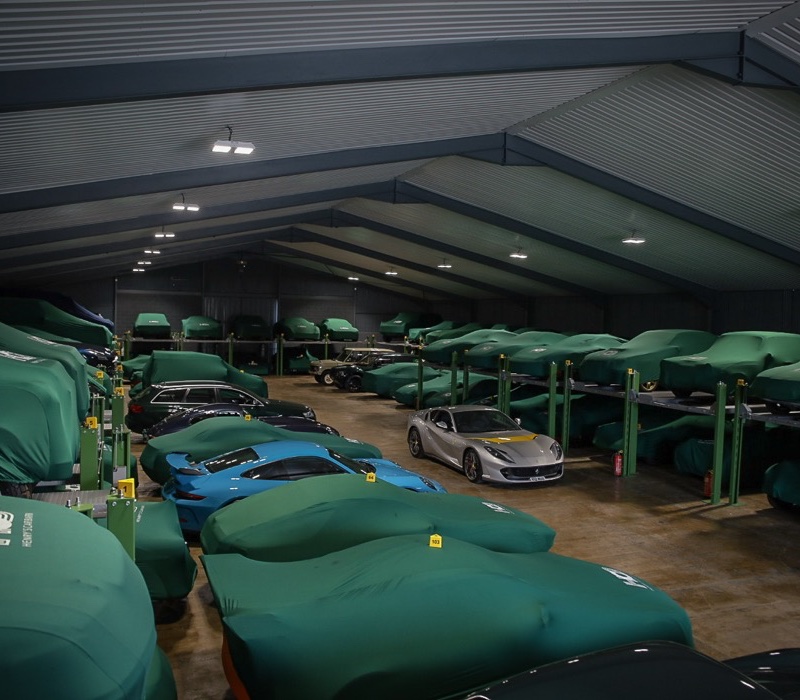
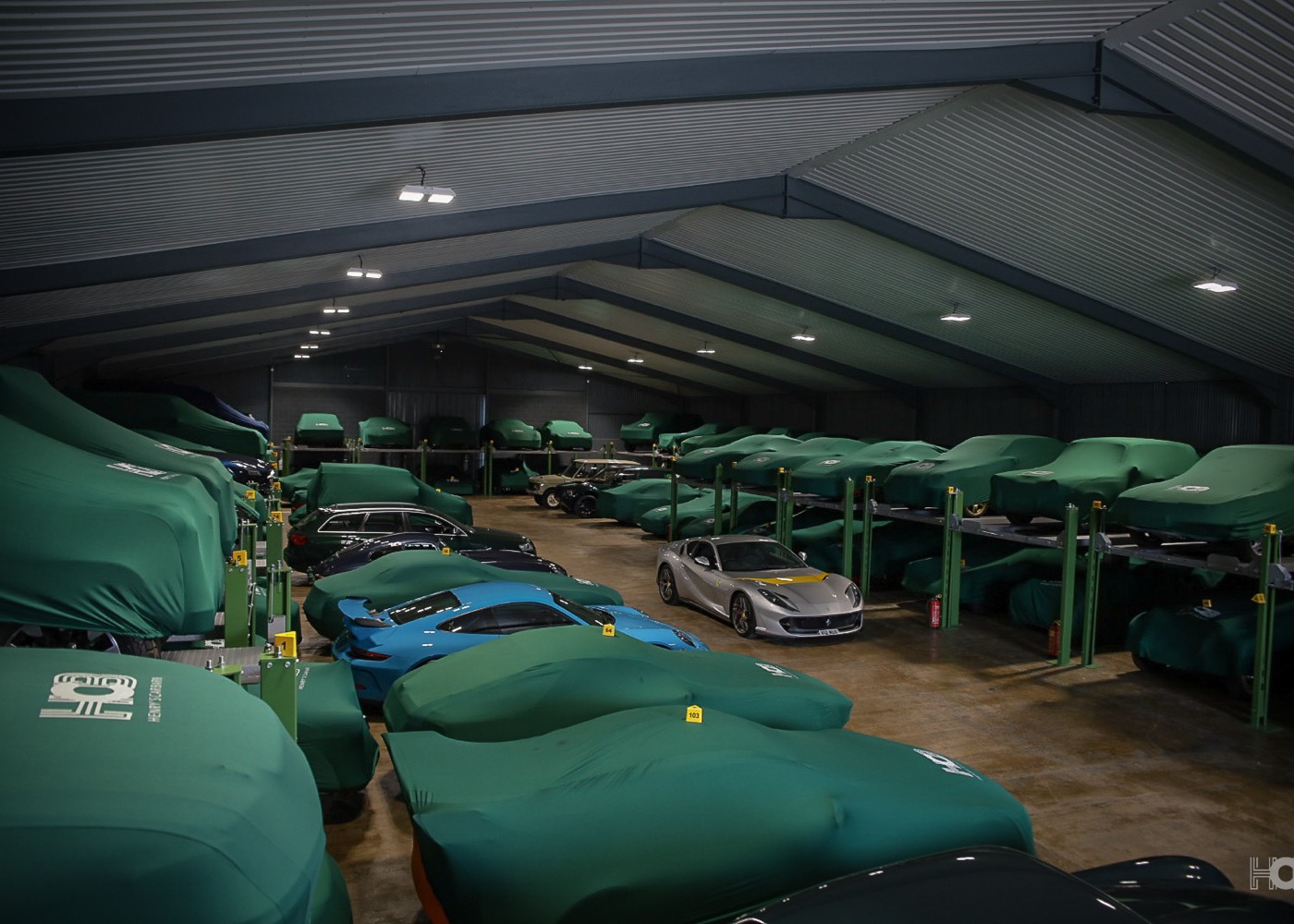
Henry’s Car Barn has provided secure car storage and collection management since 1984, from sites in Warwickshire, Hampshire, West Sussex, London and Northumberland. The main building is fully dehumidified, the site is inspected daily, battery conditioners are checked weekly, and roughly every sixty days each car is uncovered, started, run up to full operating temperature and moved.
Cars arrive on our own transporter or under their own steam, are inspected and photographed before going into their bay, and are put away with the handbrake off, a breathable cover and a drip tray. Pennant Classics, our workshop, is on the Warwickshire site, so anything the car needs can happen without it being moved again.
And if, having read the above, a self storage unit near you is obviously the right answer for the car you have in mind, use one. We would rather tell you that now than take money for something you did not need. If it is not the right answer, get in touch and we will talk it through properly, including the parts you could perfectly well do yourself.