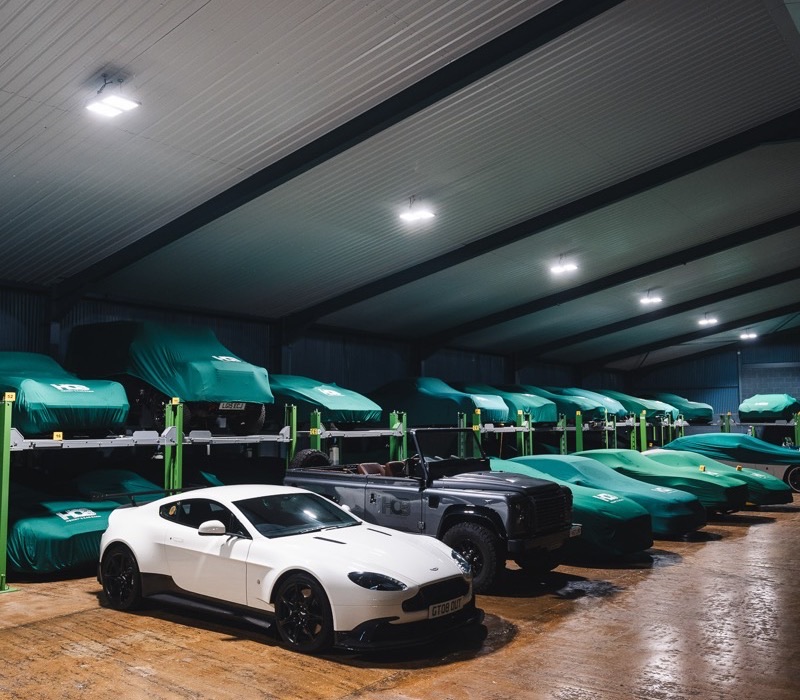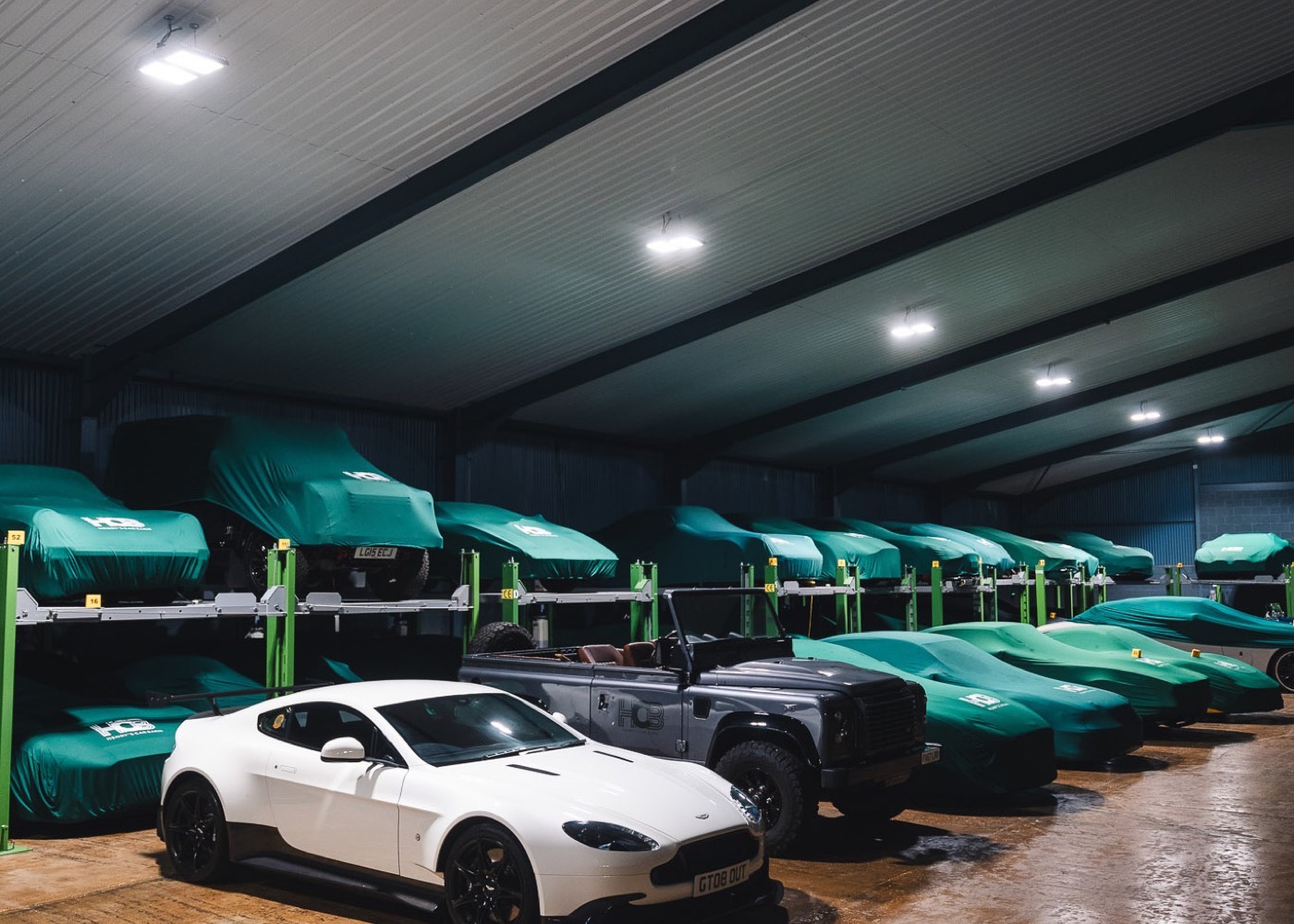
A building holds one temperature, one humidity, one security regime and one set of doors. The cars inside it do not agree about what they want.
Storing one car is a question with a single answer. You work out what that car needs, you do it, and the car is fine.
Storing eight is a different question. It asks how many different answers can live under one roof, and who is keeping track of which car got which. Almost everything that goes wrong with a stored collection goes wrong in the gap between those two questions.
Here is where the disagreements actually are.
Damp, rather than cold, is what damages a stored car. Clean steel will sit in dry air almost indefinitely. What starts the reaction is a film of water on the surface, and below a certain humidity that film does not form at all. Published atmospheric corrosion data puts that threshold at around 60% relative humidity for iron in air free of pollutants. Hold a building below it and the chemistry largely stops. That is why a specialist storage building tends to sit somewhere in the fifties: under the threshold with margin to spare, and not so dry that leather, natural rubber and any timber in the car begin to suffer from the other direction.
The important word in that paragraph is clean. Sixty percent is the figure for a clean surface. Salt moves it, and it moves it in the direction that matters most after a British winter.
UK roads are treated with rock salt, which is largely sodium chloride, and that salt is frequently pre-wetted with sodium chloride or calcium chloride brine before it is spread. Those two chlorides behave very differently once they are sitting in a wheel arch or along a sill.
Read the third row twice. Calcium chloride pulls water out of the air at a humidity far below anything a storage building would ever be held at. A car carrying that residue stays wet at 55%, at 45%, at 35%. The water is being held by the salt rather than by the air, so dehumidifying the room does not reach it.
There is no dehumidifier setting that dries out a salted car. The salt has to come off before the car goes in.
This is the mechanism behind advice that otherwise sounds like housekeeping. Washing and drying a car properly before it is stored does more for it than most of what happens during the storage itself, because it removes the one contaminant that the building's own controls cannot overcome.
For a single car, that is a job on a Saturday. For a collection it has to become a policy, because the cars arrive at different times, off different journeys, in different states. The one that came in unwashed on a wet February afternoon is now parked next to eleven that were prepared properly, and it is the only one quietly working on itself.
The second thing a collection cannot standardise is what is in the tanks.
The Federation of British Historic Vehicle Clubs recommends that vehicles built before 2000, and some early 2000s vehicles considered non-compatible, run Super E5 Protection grade petrol rather than E10. Their reasoning is chemical and specific. Ethanol has greater acidity, conductivity and inorganic chloride content than petrol, which is essentially neutral, and can therefore cause corrosion in a fuel system. Seals and flexible pipes made for an older fuel swell and soften when exposed to ethanol blends, which weakens the structure of the elastomer, and then shrink and crack as they dry out.
Their lay-up advice is more specific still, and it runs against instinct in two places. For a vehicle laid up for an extended period they recommend replacing E10 with ethanol-free petrol where a supplier can be found. And they say plainly that fuel systems should not be left dry, because a dry system corrodes and the same elastomers shrink and crack.
So a pre-2000 car wants the right fuel, and it wants to be full of it. Meanwhile a modern car in the same building has a sealed fuel system, tolerates E10 by design, and has a different concern entirely, which is that petrol degrades on its own timescale and the car wants reasonably fresh fuel in it when it comes back out.
There is also a physical difference that gets overlooked. A carburettor car has float bowls, which are small open volumes of fuel with a vent to atmosphere. The light fractions evaporate out of them and leave gum and varnish behind. A modern sealed injection system has no equivalent exposure. Two cars, parked a metre apart, with genuinely different requirements for what should be sitting in them in January.
Across a mixed collection that is at least two fuel policies, and the only workable way to run two policies is to record which car is on which, rather than to remember it.
A lead-acid battery forms lead sulphate on its plates as it discharges. That is ordinary chemistry and it reverses when the battery is charged again reasonably promptly. Left sitting discharged, the fine sulphate crystals grow into larger, harder ones that do not readily convert back, and the battery loses capacity permanently. That is why a flat battery left flat for a season is often a dead battery rather than a discharged one.
How fast a car gets there varies enormously across a collection. A modern car is never fully asleep. Alarm, telematics, keyless entry and body modules all draw current while the car sits, which is why a modern twelve-volt battery can be flat in three to four weeks. A 1960s car with a handful of electrical circuits may sit for months before it has the same problem.
The collection-scale issue is not the chemistry, which is well understood. It is the installation. Conditioning twenty cars means twenty conditioners, enough sockets and circuits to run them, and somebody physically confirming that each lead is live rather than simply plugged in. A conditioner that has tripped is indistinguishable from a working one at a glance, and the car gives no sign until you ask it to start in March.
A stationary car puts its entire corner weight through one small contact patch. The tread and belt package deflects there, and held in that position long enough it takes a set. Warmth accelerates it and cold is when it announces itself. Modern tyres, with stiffer belt construction and lower profiles, can take a permanent set from around a month of standing.
With one car, the answer is to drive it now and then. With twelve, that answer stops being real. Nobody drives twelve cars regularly, and the car at the back of the building is the one that never gets chosen.
So at collection scale, flat-spotting stops being an owner's habit and becomes a property of the storage: whether pressures are set for standing rather than for driving, and whether cars are genuinely moved on a rota or simply intended to be. Those are two different things, and it is worth asking a facility which one is actually happening.
A storage facility's cover generally carries a limit per vehicle and a total limit for the site. Store one car and only the first number is interesting. Store a collection and the second one matters just as much, because a collection concentrates a large amount of value inside a single building, which is precisely the scenario an aggregate limit exists to cap.
There is a second drift that only shows up over time. Agreed values age. A figure set when a car went into storage is a statement about the market on that date, and the market does not hold still. If several cars in a collection each sit somewhat below their current value, the shortfall does not stay small, because it adds up across every car at once.
None of this is insurance advice, and a storage company is not your broker. The practical version is short. Ask for both numbers in writing, ask how often the facility expects values to be revisited, and make sure your own policy and theirs are not each assuming the other one is covering something.
The most common frustration with a stored collection has nothing to do with chemistry. It is wanting one specific car, in March, at short notice.
Whether that is easy depends on something very unglamorous, which is how the building is arranged. Cars parked efficiently are parked closely, and a car parked behind three others requires three cars to be moved before it goes anywhere. That is fine when it is planned and irritating when it is not.
Worth establishing before a collection moves: how the building is laid out, how much notice is needed for a specific car, and who physically moves the vehicles. Transport and handling is the phase of storage where most damage happens, so whether that is done by the facility's own people or handed to a subcontractor is a fair question to ask directly.
Everything above turns into the same practical requirement. Each car needs its own record, and the record needs to outlive whoever currently remembers it.
At minimum, per car: what fuel is in the tank and when it went in, when the oil was last changed, what pressures the tyres are set to for storage, what the agreed value is and the date it was set, and who is authorised to collect the car.
That list is the honest dividing line between a building that stores your cars and a service that manages your collection. A store knows where the cars are. A managed collection knows what state each one is in.
It matters for an unhappier reason too. A collection tends to outlast the arrangements around it. If the person who holds all of this in their head is unavailable, the people who need to act, whether that is family, an executor or a buyer, need the collection to be legible without them.
The number matters less than the mix. Two cars from different eras already need two different protocols and two records. Five cars that are all modern and all similar are closer to one problem repeated. The moment the cars stop agreeing with each other about fuel, humidity tolerance and how often they need attention, it is a collection in every way that affects storage.
To the same standard, yes. To the same recipe, no. The building conditions apply to everything in it equally, and a single sensible humidity band suits almost any car. What cannot be shared is the per-car work: which fuel is left in, how often the battery is attended to, whether the car is on a moving rota. Those need to be set per vehicle and written down.
Only after it has been washed and dried thoroughly, including the underside and the wheel arches. Chloride residue from road treatment can hold water at humidity levels far below anything a storage building operates at, so it continues to work on the car regardless of how well the building is controlled. Removing the salt is the step that actually solves it.
For vehicles built before 2000, the Federation of British Historic Vehicle Clubs recommends Super E5 Protection grade rather than E10, and recommends replacing E10 with ethanol-free petrol for extended lay-up where it can be sourced. They also advise against draining the system, because a dry fuel system corrodes and its seals shrink and crack.
Frequently enough that a silent failure is caught while it is still reversible. A conditioner that tripped in November is a different problem in December than it is in April. Ask a facility what the actual inspection interval is per car and what gets recorded each time, rather than whether inspections happen.
That depends on your own policy, and it is a question for your broker rather than for a storage company. What is worth confirming on the storage side is the facility's limit per vehicle and its overall limit for the building, so you can see whether a collection of your size and value sits comfortably inside both.
Henry's Car Barn has been storing cars and collections since 1984, across sites in Warwickshire, London, Hampshire and West Sussex. Storage sits alongside collection management, transport across the UK and Europe, and on-site work including detailing and Liquid PPF installation. Owners have access to their vehicles around the clock.
As a Collecting Cars managed partner, the process for a car being sold out of a collection runs from inspection on arrival and interior and exterior detailing, through photography, storage during the auction process and viewings, communication with prospective buyers, and coordination of the handover.
If you are thinking about moving a collection, the useful first conversation is about the cars rather than the space: what they are, how they differ, and how often you actually want to be driving them.